How museum illustration brings
heritage stories to life
Illustration can make historical people feel real. I love working with museums and heritage sites because I want to connect audiences to stories from the past.
There is something fascinating about knowing that the same spaces where we live, work and walk today have held many different lives and stories before us. A museum can tell us what happened there, but museum illustration can help us imagine what it might have felt like to be there. That, to me, is where illustration becomes particularly powerful. It can take something that happened hundreds or thousands of years ago and find a point of connection with the person looking at it today. This is what I find so interesting about heritage storytelling: it isn’t just about communicating historical information, but finding ways for people to connect with it.
Museum illustration brings the past to life
What museum illustration can be used for
One of the obvious advantages of museum illustration is that it can show things we have no photographic evidence of. We can illustrate objects that no longer exist, people whose faces we don’t know, buildings that have disappeared and events that happened long before photography was invented.
But illustration can do more than simply fill in the gaps. It can bridge the time between different events, bring several elements of a story together and make informed suggestions about colour, clothing, activities and surroundings. It can create an atmosphere or feeling that modern audiences can connect with just as readily as people in the past might have done.
In fact, I think illustration is particularly good at communicating universal truths – things that don’t really change between generations. Most often feelings: curiosity, mischief, love, boredom, ambition, fear, joy and connection don’t belong to any particular period of history. Illustration can help us recognise those feelings in people who lived long before us.
Of course, this freedom also creates a difficult question: how much should we invent?
The line between historical accuracy and interpretation
There is a lot of debate within the heritage sector about how much historical detail can be and should be invented when producing heritage interpretation. When I start a project, I ask my clients for as much information as they can give me – not just information directly about the subject, but anything around it that might help me understand the context. I then read through the material and carry out my own research, both visual and written. This type of research is an important part of understanding not just what happened, but which details might help communicate the story visually.
I’m an illustrator rather than a historian, so I don’t assume that I can independently determine whether every piece of information I’ve found is historically reliable. I’ll often create something based on my findings and then ask my clients to check it for accuracy, sharing the sources I’ve found along the way.
Visitor interpretation
The difficult part comes when the evidence simply isn’t there. Imagine, for example, that you are creating an illustration of an Iron Age settlement. You may have archaeological evidence about the site, objects that have been discovered and some knowledge about how people lived. But you probably don’t know exactly what a particular person looked like, what colour their clothes were or precisely how they used a specific site where the objects had been found.
Sometimes the question is even more complicated than reconstructing a historical scene. For the Health Histories project, for example, I had to imagine what someone might have looked like had they not spent twenty years in an asylum.

There was no photograph that showed this person at that point in her life, so the illustration wasn’t simply a matter of reproducing an existing image. I had to think about what could reasonably be inferred from the evidence and then create a possible version of the person she might have been.
I find projects like this particularly interesting because they make the boundary between historical fact and interpretation very visible. The illustration isn’t saying this is what she looked like. It’s asking the viewer to imagine a life that she might have led. The distinction is important, particularly when an illustration is being used as part of visitor interpretation, because audiences don’t always distinguish between an artist’s interpretation and historical evidence so making that explicit is crucial.
This is one of the reasons I think the relationship between historical accuracy and an evocative image is so complicated. Illustration needs to make decisions, but those decisions need to be transparent enough that we don’t accidentally turn speculation into fact.
I’ve experienced a similar dilemma when creating an illustrated interpretation board for an archaeological project. The aim was to engage people who now live on the same site where the archaeological finds came from. Creating characters from the past could have been a great way of making that connection, but it would have also meant that we were giving the viewer a very specific image of what those people might have looked like so we took a different direction.
There isn’t a single answer to this problem. You can argue it either way. Personally, I think the gain often outweighs the potential damage if the characters are well researched and, crucially, the accompanying text makes it very clear that the illustration represents one possible interpretation, rather than a definitive historical record. But I understand why some people working in the heritage industry feel uncomfortable with that approach and I am here to serve the purpose of my clients in the best possible way, which why I always start with their audience.
Start with your audience
Who would you like to attract?
One of the questions I think museums need to ask more often is: who are we actually trying to talk to? It sounds obvious, but audiences are often described in very broad terms: families, children, tourists, locals, culture vultures. Those descriptions aren’t necessarily very helpful to an illustrator.
If you tell me that your museum wants to appeal to “culture vultures”, I still don’t know what that means in your specific practice. I need to put myself in the shoes of that person and think about what they would actually find interesting. Perhaps they enjoy discovering little narrative details that enrich an image – things that you don’t notice at first, but which reward closer attention. That is a much more useful insight than simply knowing their demographic label.
This is particularly important when thinking about visitor engagement. This approach is also reflected in current guidance for heritage organisations: the National Lottery Heritage Fund recommends putting target audiences at the heart of interpretation planning, including thinking about what visitors should feel, learn and take away from an experience.
Knowing who your audience is isn’t enough; you need to understand what they might want to discover, what might surprise them and what might make them care about the place you’re interpreting. If I had the freedom to start a museum illustration project from scratch, I’d want to ask questions such as: Who would you like to speak to with your new illustrations? Why do you want to speak to this particular audience? Perhaps not enough people from that group visit your site. Or perhaps they are already your core audience and you want to give them more reasons to engage.
Then I’d ask: How would you like those people to feel when they leave? And perhaps most importantly: What is special about this place to you? Why do you love working here? Those questions can start to reveal something that isn’t necessarily obvious from the formal history of a site.
Find the human stories in the archive
Museums and heritage organisations have enormous amounts of information available to them. But not every interesting fact makes a good illustration. Sometimes the most engaging story isn’t the most important event in a site’s history. It might be a small, funny, unexpected or very human detail.
I worked on a project at Kelmscott Manor where the brief was to portray the Morris family at the point when they moved to the Manor. The illustrations needed to show real people and be playful, but they also couldn’t feel childish. The colour palette needed to sit within the world of William Morris, and the overall approach was a modest line drawing rather than a highly rendered historical reconstruction.
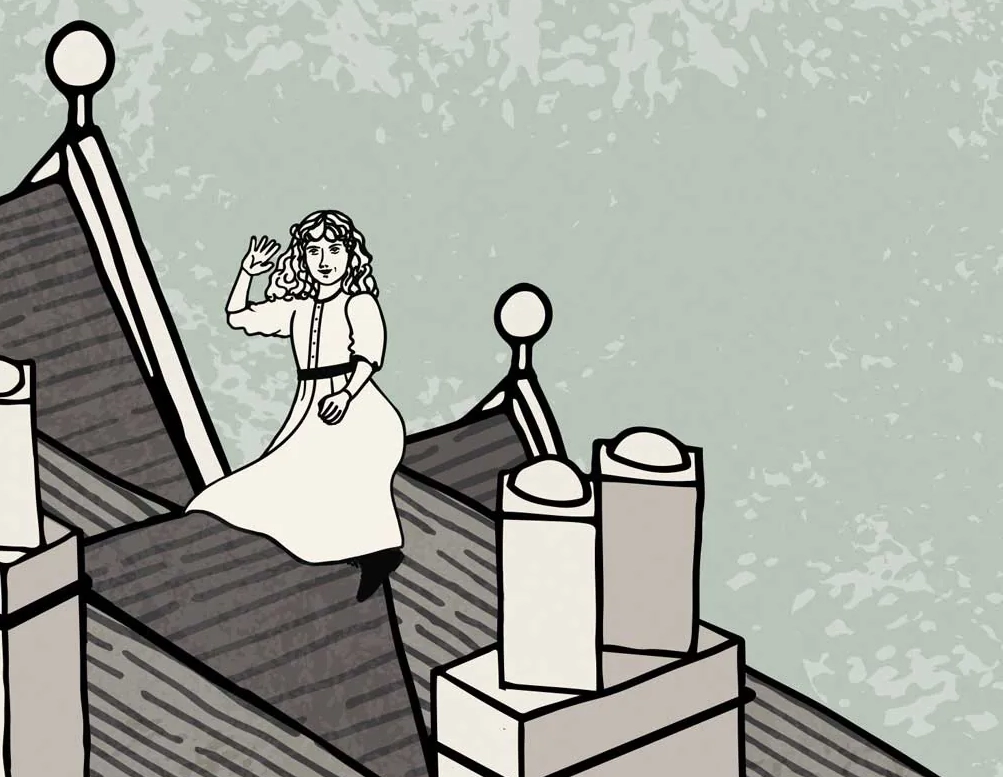
The solution was to let the activities provide much of the personality. May Morris is shown riding on the roof of the estate. Her sister is reading beside the river. William Morris is cutting the famous hedge in the garden, while May’s mother is picking apples.
I particularly like the May Morris illustration because it demonstrates what illustration can do with historical characters. Photographs of May Morris can give us information about what she looked like, but in them she often appears quite stern. In the illustration, she smiles.
This was a joint decision we made with the team as we felt it wasn’t about ignoring the historical record. It was about finding a way of communicating something human. The activity itself is historically correct and suggests a sense of mischief in the first place, while the character’s expression and the simplicity of the drawing create warmth. Someone who lived decades ago suddenly feels a little more like someone we might have known and that connection matters when we want to build audiences.
Creating connections
Illustration needs to talk to us
I often say that good visitor interpretation needs to talk to you. We naturally look for warmth and understanding from the people around us. An illustration can do something similar. It can communicate personality through what a character is doing, through facial expressions and even through small things such as the way their clothes fold. Those details can make a historical figure feel like a person rather than an item of historical information. This is particularly important if the aim is to engage people who don’t already consider themselves interested in history. You don’t necessarily need to give them more facts. You need to give them a reason to care.
One of the most exciting possibilities of museum illustration is that it can reward people who look closely. A strong illustration doesn’t necessarily have to communicate everything immediately. You can build in narrative details that aren’t obvious at first sight. A visitor might notice one thing as they walk past and then discover another detail when they look again.
That can be particularly effective for audiences who enjoy exploring and discovering rather than simply receiving information. It also allows museums to layer their communication. If a project needs to speak to several different audiences, the answer isn’t necessarily to create completely separate experiences. You can layer the messaging through both the words and the visuals, allowing different people to take different things from the same illustration.
The Museums Association similarly puts audiences and communities at the heart of museum practice, emphasising the importance of understanding different visitors and finding multiple ways for people to engage with collections and experiences. Museums Association: Engaging Audiences and Communities
It isn’t straightforward – and there is never a single solution – but that complexity is part of what makes museum interpretation interesting. The same approach can also make cultural heritage artwork feel less like decoration and more like part of the storytelling itself.
Tips for interpretation projects
What should you think about before commissioning a heritage illustrator?
If you’re a museum or heritage organisation considering an illustration project, here are some tips about how you can approach your project before searching for a visual style:
- Think about your primary audience. Who do you want to reach, and why? Is there a group that currently doesn’t visit your site enough, or are you trying to give your existing audience more reasons to engage?
- Then think about how you want them to feel. Do you want them to feel curious? Connected? Amused? Inspired? That emotional response can be just as important as the information you want them to remember.
- And finally, look at your own archives. What stories can you find that make your organisation feel relatable and real rather than simply a thing of the past? Those small human stories can be incredibly powerful.
Undeniably, you will need the basics in place in order to get quotes for your project that define the scope. But in order to get the best out of an illustrator, you could start your brief with something like this: “We find […] fascinating about our site. We want other people to feel the same way.”
Illustration isn’t just about showing the past
For me, working with museums and heritage organisations is ultimately about connection. Illustration can show us things that no photograph ever could. It can bridge gaps in the historical record, suggest possible versions of people and places, and create atmosphere where factual information alone might feel distant.
But its real strength is its ability to make the past feel human. A person who lived hundreds of years ago had hopes, habits, relationships, frustrations and moments of fun. They lived in the same physical world that we inhabit now, even if that world looked very different. Those feelings are universal, and museum illustration gives us a way of recognising ourselves in people from the past.
Perhaps that’s the most powerful thing illustration can do in a heritage setting. It can remind us that the past happened here, that real people lived these lives and that despite the enormous differences between their world and ours, they weren’t necessarily so different from us after all.

Illustrated heritage
I work with museums, heritage organisations and cultural projects to create illustration that helps audiences connect with the stories behind the places they visit.