
Illustrating meaning in posters
How research into the history and symbolism of Postman’s Park informed the illustration for a poster celebrating this quiet corner of the City of London.
Last modified: 3 November 2026
Introduction
Postman’s Park is a small green space in the City of London, close to St Paul’s Cathedral. Surrounded by busy streets and modern office buildings, it offers a quiet place to sit and take a break from the city.
The park is home to the Watts Memorial, a wall of commemorative tiles recording the stories of ordinary people who lost their lives saving others. These accounts of courage and selflessness give the park a particular significance. I wanted to explore some of these ideas in a poster illustration, looking at the relationship between the park, its history and the surrounding city.
Inspiration
Postman’s Park takes its name from the nearby General Post Office building. It was once a popular lunchtime spot for postmen and remains a place of quiet reflection amid the activity of the City.
The Watts Memorial commemorates 52 acts of heroism. Alongside the memorial is a quotation from G. F. Watts:
“The material prosperity of a nation is not an abiding possession; the deeds of its people are.”
The stories on the tiles are a reminder of the people behind these acts of courage. I was interested in the contrast between this history of ordinary people helping others and the business-focused environment surrounding the park.
The symbolism of flowers
in Victorian tiles
The memorial’s tiles, created by Victorian artists William de Morgan and Doulton, also feature floral imagery. Flowers had particular meanings in Victorian culture, a tradition known as floriography or the language of flowers. The Royal Horticultural Society has a useful introduction to this tradition in its guide to the meaning of flowers.
For example, bluebells were associated with humility and constancy, while tulips could represent deep love. As some of the first flowers to appear in spring, they can also suggest renewal and hope.
I was interested in these associations and how they could add another layer of meaning to the poster.
Creating the illustration
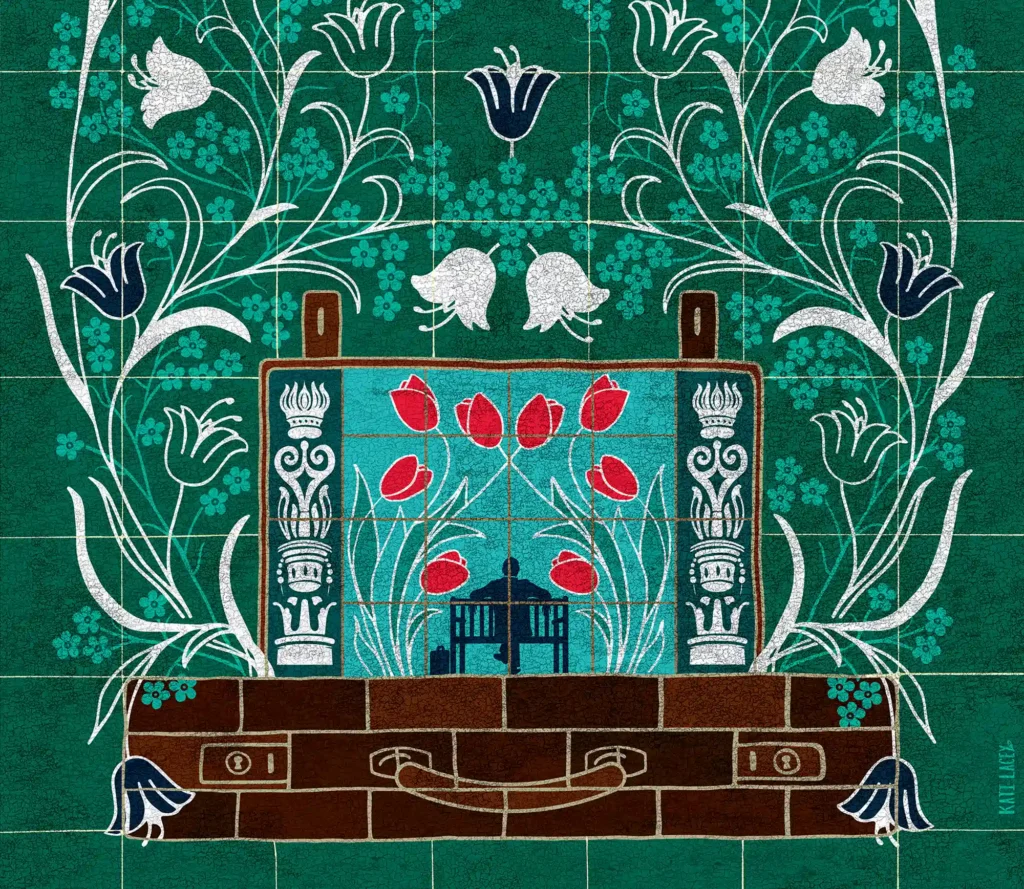
I used flowers as a central feature of the illustration, with bluebells and tulips representing the ordinary people commemorated on the Watts Memorial. A businessman looking towards the flowers brings the surrounding City of London into the scene, while the lightly drawn skyline provides a contrast with the quieter setting of the park.


The Forget-Me-Not sign takes inspiration from the familiar Underground roundel. It connects the illustration to London while also referring to the importance of remembering the stories on the memorial.
The floral patterns framing the poster are inspired by the botanical designs of William Morris. I wanted to draw on the visual language of Victorian decorative arts, while the tiled surface and crackled texture refer back to the memorial itself.
Postman’s Park brings together several different histories: the stories recorded on the Watts Memorial, its Victorian origins and its place in the modern City of London. The illustration gave me an opportunity to bring some of these elements together in one image.

Planning a poster or leaflet?
I design illustrated posters and leaflets for theatres, museums, festivals and heritage sites, with the lettering designed as part of the illustration.